We deliver intelligent, AI-powered software solutions that enhance system performance, automate testing and enable smart decision-making across automotive and embedded platforms.
Services
Software Development And Services
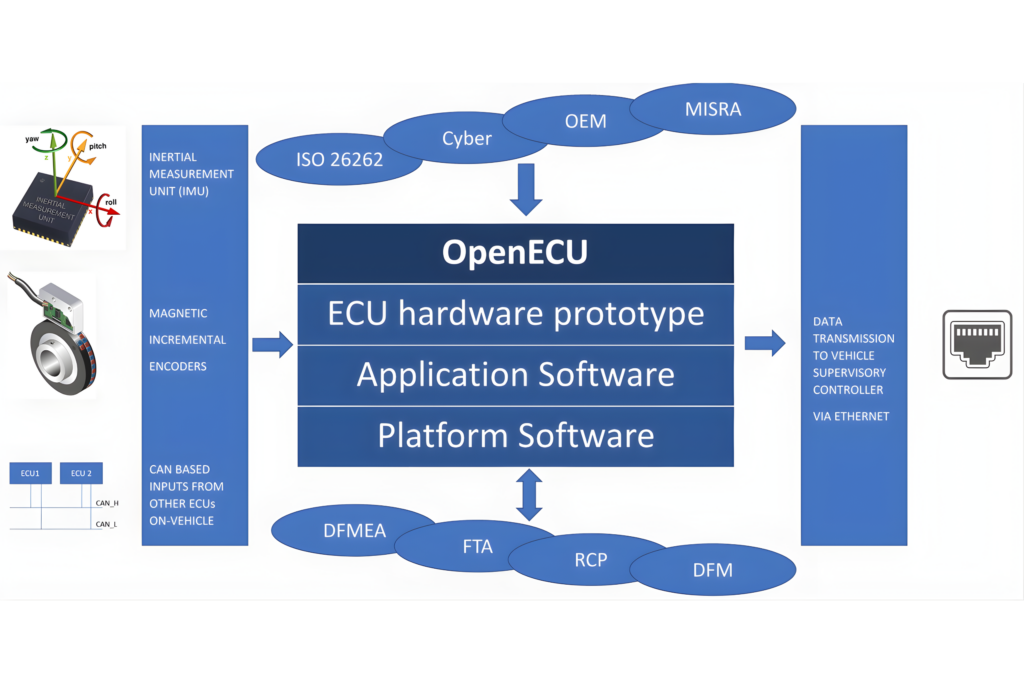
Vehical ECU Development services
We provide complete Automotive ECU development solutions covering hardware, firmware, software, testing, and compliance with global automotive standards.
- A core backend technology for secure server-side development, data processing, and system integration. PHP enables reliable communication between databases, applications, and testing systems.
- CAN, LIN, FlexRay, and MOST protocol experience
- UDS, J1939, KWP2000, ISOBUS & OBD-II integration
- Third-party automotive stack integration
- CAN, LIN, FlexRay, and MOST protocol experience
- UDS, J1939, KWP2000, ISOBUS & OBD-II integration
- Third-party automotive stack integration
- Unit, integration, and functional testing
- Model-in-the-Loop (MIL) testing
- Hardware-in-the-Loop (HIL) testing
- ECU software validation and performance testing
- Functional safety consulting services
- ASIL-A to ASIL-D compliant ECU development
- ISO 26262 safety planning and lifecycle management
- AUTOSAR 4.0 compliant ECU software
- RTE, BSW & COM stack configuration and integration
- MCAL development
- Communication and I/O driver development
- Tool expertise: Vector, Comasso, ECU Spectrum, KSAR AUTOSAR
- DaVinci Developer for ECU architecture design
- Automotive-grade embedded hardware design
- ECU, gateway, and sensor interface development
- PCB design and layout optimization
- HIL support and rapid prototyping
- Design for manufacturability and testability
- Embedded firmware and ECU application development
- AUTOSAR and non-AUTOSAR software
- Communication and diagnostics software
- Requirement analysis and system architecture
- Functional and safety concept design
- Agile and V-model based development
- Schedule, quality, and risk management
- MIL, SIL, HIL, and vehicle-level testing
- Compliance and performance validation
- ISO 26262, AUTOSAR, Automotive SPICE support
Our Software Services
Hardware Development, Software Development, System Engineering, Project Management, Verification & Validation and Compliance with Standards together form a complete product development ecosystem. Our Hardware Development services include custom design of automotive-grade embedded hardware, ECU, gateway and sensor interface development, advanced PCB design and layout optimization, Hardware-in-the-Loop (HIL) support with rapid prototyping, and design for manufacturability and testability to ensure reliable, scalable and high-quality automotive electronic solutions.
Our Software Services
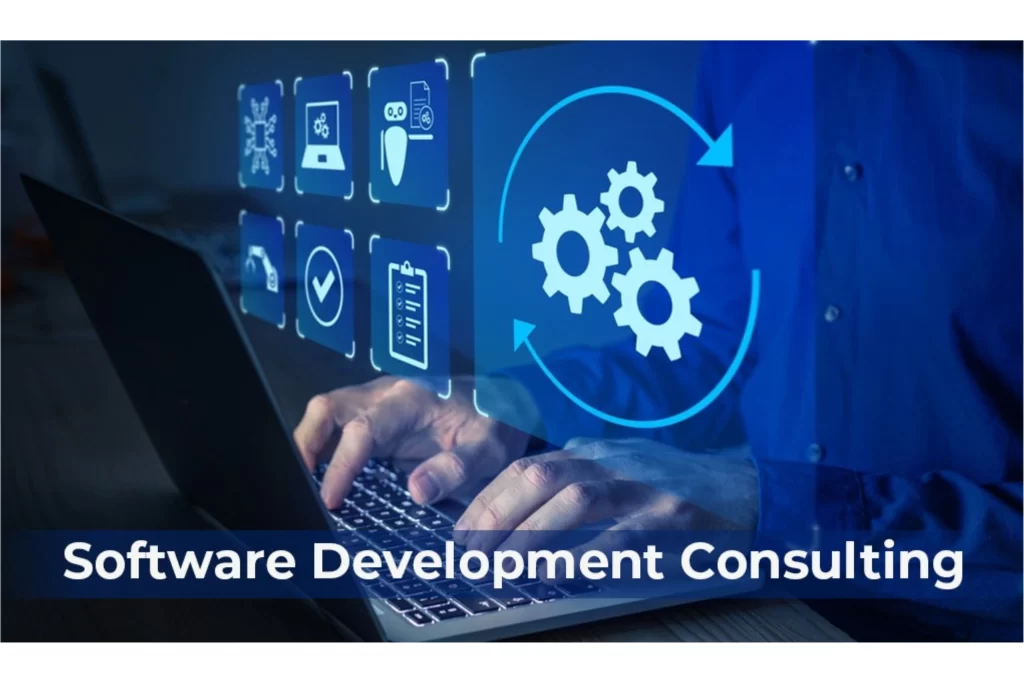
Software Development Consulting
Forget idealism—today’s reality is that new ventures aiming to launch their software products must invest time and effort in software consulting to stand out in a fast-paced, innovative and highly competitive business market. Success now depends not only on ideas but also on strategic planning, technical expertise and market-driven execution.
Understanding the Real Challenge:
Analyzing market trends and developing a product that truly meets customer expectations is not a one-person task. Even technology-driven businesses with skilled teams often need expert software consulting to gain the right direction, reduce risks, and make smarter development decisions.
How Software Consulting Creates Value:
Software consulting provides guidance at every stage of the product lifecycle—from idea validation and planning to development and deployment. It ensures that the software is built with the right technology, architecture, and scalability to support business growth and customer satisfaction.
We Are in the Midst of a Software Consulting Boom:
No matter the size of a business, managing operations without modern technology is nearly impossible. Continuous technological innovation has transformed how organizations function, compete, and deliver value. Software consulting enables businesses to adapt faster, improve efficiency, and stay competitive in today’s digital-first world.
End-to-End Expertise
All-in-one software, engineering, automation and testing
Reliable Testing
Precise, dependable testing for critical systems
Future-Ready Innovation
Smart digital manufacturing integration
On time Delivery and Installation Commitment
Timely delivery and installation as per commitment.
World Class Solution with Cost Effective
Global-standard solutions at optimized cost.
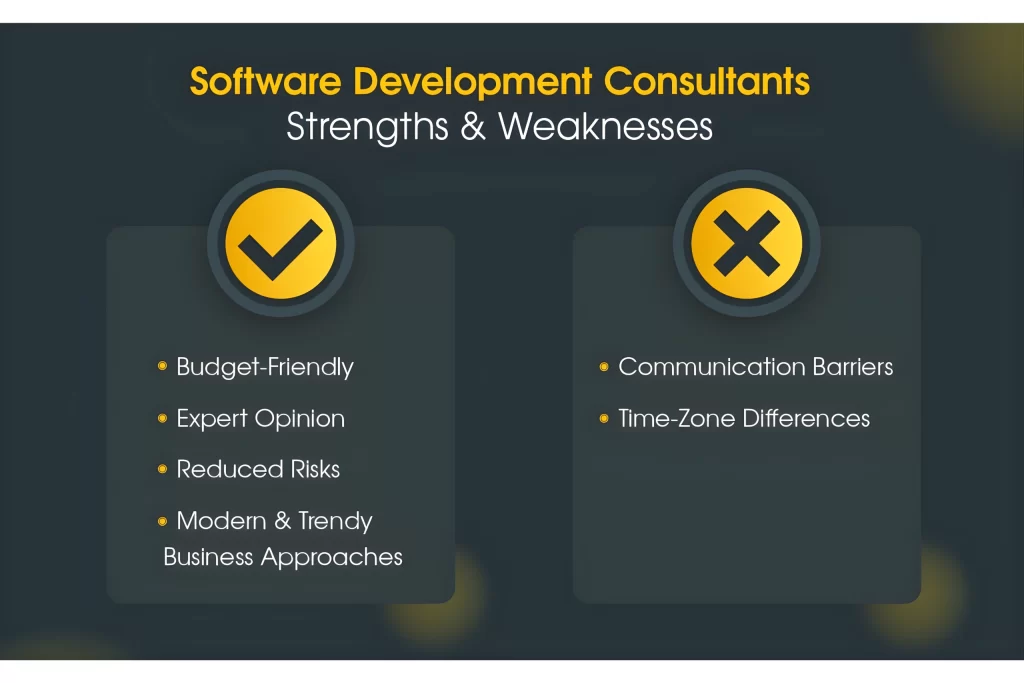
Advantages And Disadvantages Software Consulting Services
Some of the key advantages of hiring software consultants are:
Advantages of Software Consulting Services
Get cost-effective software solutions without compromising on quality. Hiring remote or part-time consultants reduces operational costs while delivering reliable performance. You can also partner with a dedicated team from a reputed software company to access full-scale services at affordable rates.
Software consultants bring industry experience and technical expertise that help businesses make smarter decisions. With a wide pool of specialists, they provide unbiased guidance and implement the latest technologies to strengthen your business model.
Experienced consulting firms ensure smooth integration of new IT solutions. Their expertise helps minimize errors, protect business data, and handle system migration efficiently, reducing operational and technical risks.
Consultants design solutions aligned with current market trends and future business goals. By understanding your long-term vision and stakeholder needs, they deliver innovative, scalable and technology-driven systems.
Disadvantages of Software Consulting Services
Working with global consultants can sometimes create communication challenges due to language differences and varied work cultures. These gaps may lead to misunderstandings or delays if not managed properly.
Outsourced teams often operate in different time zones, which can affect meeting schedules, response times, and project timelines. This may slow down decision-making if coordination is not well planned.
When working with external consultants, businesses may have less day-to-day control over the development process. This can require stronger monitoring, reporting, and collaboration to keep projects aligned with goals.
Relying on third-party consultants means project progress depends on their availability and priorities. Any delays, workload changes, or resource issues on their side can impact your project delivery.
Testing Methods In Automotive
Automotive systems are becoming increasingly complex, with the integration of advanced control algorithms, software, and hardware components. Ensuring that these systems function correctly and reliably before deployment is a critical challenge in the automotive industry. To address this, engineers employ various testing methodologies that allow for progressive validation, from early-stage simulations to real-world testing.
Testing techniques used in automotive development:
▶ SIL – Software-in-the-Loop
▶ MIL – Model-in-the-Loop
▶ PIL – Processor-in-the-Loop
▶ HIL – Hardware-in-the-Loop
Model-in-the-Loop (MiL) Testing
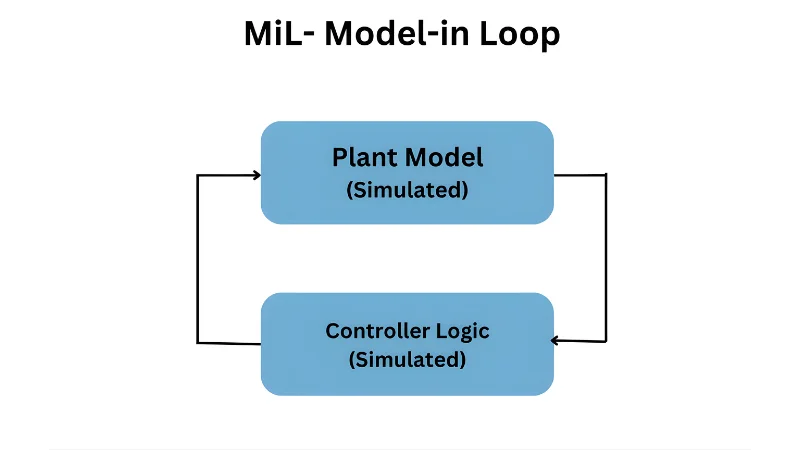
Model-in-the-loop (MiL) is the first stage in the testing process. In MiL, both the plant—which represents the vehicle’s dynamics—and the controller, which houses the control algorithms, are fully simulated. This early testing phase allows engineers to develop and refine algorithms without the need for any hardware.
Software-in-the-loop (SiL)
Software-in-the-loop (SiL) is the next step in the validation process. At this stage, the plant is still simulated, but the controller is now the actual software code that has been written and compiled. For example, if SiL is developed in Simulink, S-functions will be found inside the controller. SiL bridges the gap between theoretical design and practical implementation.
Processor-in-the-Loop (PiL)
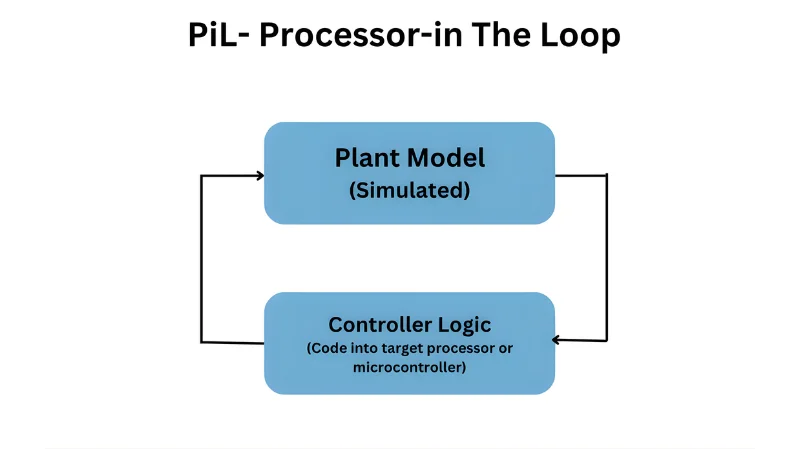
Processor-in-the-loop (PiL) adds another layer of realism. While we continue using a simulated plant, the controller code now runs on the target processor or microcontroller. This is crucial for evaluating the real-time performance and execution characteristics of the code.
PiL testing verifies that the hardware can handle the computational demands of the software. It helps identify any timing issues, latency, or performance bottlenecks that might occur once the system is deployed in a real-world scenario.
Hardware-in-the-loop (HiL)
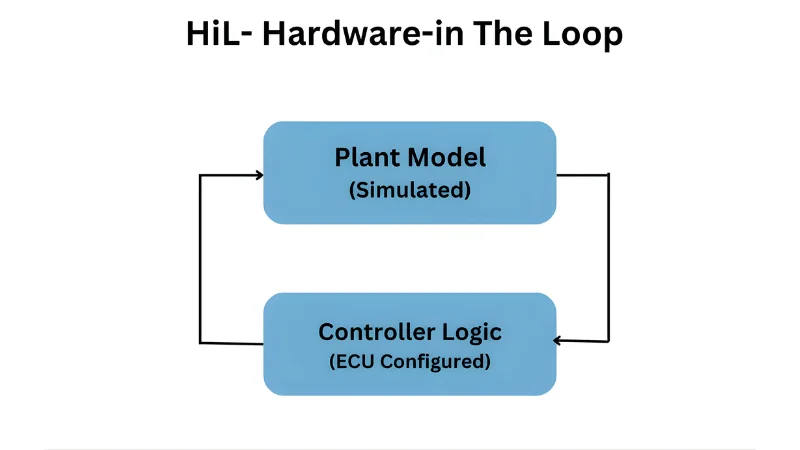
Hardware-in-the-Loop (HiL) is where we introduce real hardware into the testing process. Although the plant model remains simulated, the ECU operates in its true hardware configuration. HiL testing is critical because it validates the ECU’s behavior in a controlled environment, ensuring that it will perform reliably when integrated into the vehicle.
Model-in-the-loop (MiL) is the first stage in the testing process. In MiL, both the plant—which represents the vehicle’s dynamics—and the controller, which houses the control algorithms, are fully simulated. This early testing phase allows engineers to develop and refine algorithms without the need for any hardware.
By using virtual models, designers can quickly iterate on control strategies, simulate various scenarios, and identify issues early on. It’s a cost-effective way to validate ideas before any physical prototypes are built.
Software-in-the-loop (SiL) is the next step in the validation process. At this stage, the plant is still simulated, but the controller is now the actual software code that has been written and compiled. For example, if SiL is developed in Simulink, S-functions will be found inside the controller. SiL bridges the gap between theoretical design and practical implementation.
Testing the actual code within a virtual plant environment helps developers catch software bugs, verify algorithm accuracy, and ensure that the code behaves as expected before it ever meets hardware.
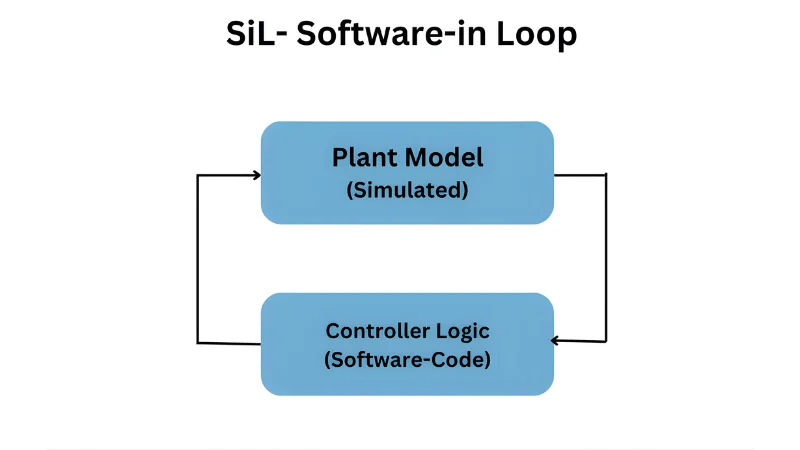
Processor-in-the-loop (PiL) adds another layer of realism. While we continue using a simulated plant, the controller code now runs on the target processor or microcontroller. This is crucial for evaluating the real-time performance and execution characteristics of the code.
PiL testing verifies that the hardware can handle the computational demands of the software. It helps identify any timing issues, latency, or performance bottlenecks that might occur once the system is deployed in a real-world scenario.
Hardware-in-the-Loop (HiL) is where we introduce real hardware into the testing process. Although the plant model remains simulated, the ECU operates in its true hardware configuration. HiL testing is critical because it validates the ECU’s behavior in a controlled environment, ensuring that it will perform reliably when integrated into the vehicle.
By simulating a variety of operational scenarios, engineers can detect potential issues, fine-tune performance, and guarantee that the system meets all safety and performance standards before full-scale vehicle integration.
Software Technologies & Development Capabilities
At KAPVL Automation Technology Pvt. Ltd., we leverage industry-proven programming languages and web technologies to build robust, scalable, and high-performance software solutions for automotive testing, automation, and digital manufacturing.Our expertise spans web technologies, embedded systems, and real-time control software, enabling seamless integration between software, hardware, and testing platforms.
Technologies We Use:
- HTML & CSS – Structured, responsive, and user-friendly web interfaces.
- PHP – Secure backend development, data management, and system integration.
- JavaScript – Interactive dashboards, real-time data visualization, and automation logic.
- Python – Automation scripting, data analysis, test orchestration, and simulation support
- AI – Intelligent analytics, predictive diagnostics, and smart testing optimization